Nov 5, 2026 · @Timo
Happy Nordic Living at the Ukraine Annual Housing Conference 2026
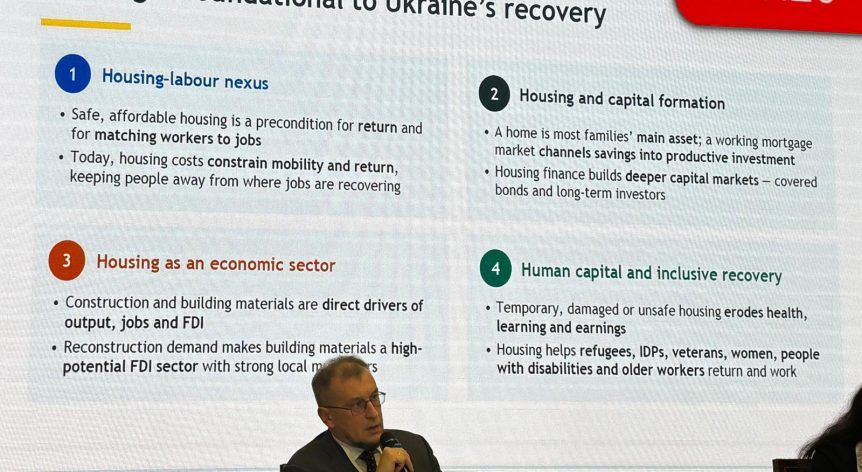
At this year's Ukraine Annual Housing Conference, the World Bank presented one of the clearest pictures yet of Ukraine's housing market. Its core message was simple: housing is not only a cost of the war. It is one of the few levers that moves the return of people, the recovery of jobs and the growth of investment at the same time.
We listened closely, because the data speaks directly to the platform we are building. Below are the findings that matter most and what they mean for Happy Nordic Living.
The buffer is running out
Housing is the sector hit hardest by the Russian invasion, with USD 61.1 billion in direct damage and 14% of the stock damaged or destroyed. On paper Ukraine still has slightly more homes than households, 14.8 million units for 13.9 million households. But the margin is thin. As refugees return and older buildings fall out of use, the World Bank expects the numerical surplus to disappear by 2028 to 2029. A stronger recovery would turn it into a shortfall sooner.
What it means for us: new housing capacity takes years to build. Our factory is planned to start production in 2028, exactly when the market moves from surplus to deficit. Industrial capacity has to be ready before the shortage shows, not after.
Build where the jobs are
Job vacancies have recovered most in western and central Ukraine, in several oblasts well above pre-war levels, while the east lags far behind. Rents follow the jobs. Housing has become the obstacle that keeps people away from work: buying a home costs more than five years of salary in most oblasts, and renting takes over 30% of income. New construction starts tell the same story. Only the West is building above pre-invasion levels.
What it means for us: our focus on the Kyiv region and western Ukraine is where demand is durable. The World Bank also warns against isolated new estates with poor access to jobs and services. We agree. HNL Villages are planned as complete, well-connected communities within reach of existing towns, workplaces and services, not as standalone projects in empty fields.
Make it in Ukraine
The import share of construction materials rose from 14% to 23% between 2021 and 2023, yet up to 90% could be produced domestically. The World Bank sees around EUR 4 billion of private investment potential in low-carbon building materials, and the EU's carbon border mechanism makes low-carbon production even more valuable.
What it means for us: this is the case for our factory. Nordic timber element technology, produced in Ukraine, with Ukrainian timber and Ukrainian workers. Timber is a low-carbon material by nature, and every element made in Ukraine keeps value and jobs in the country instead of adding to the import bill.
Better homes, not just more homes
Around 37% of households live in homes with moderate or worse damage, and outside the frontline areas most of it comes from decay and poor maintenance, not the war. Ukraine needs housing that lasts and costs less to live in.
What it means for us: our homes are built to nearly zero-energy (NZEB) standard, with precise factory quality and Nordic building practice. Lower energy bills and a long service life are part of affordability, not extras.
Trust unlocks the money
This was the most striking part of the presentation. Mortgage lending in Ukraine is only about 0.5% of GDP, against 7 to 21% in Central and Eastern Europe. Buyers' advance payments fund 57 to 80% of construction costs, usually without escrow or protection. More than 1,300 developers work without a licence or track record, and banks keep construction loans below 1% of their portfolios. The World Bank estimates that reforms could unlock an additional USD 20.9 billion of private finance for housing by 2035.
What it means for us: the developers who will attract that capital are the ones that buyers, banks and international lenders can trust. Happy Nordic Living is built on Nordic governance, transparent ownership and the track record of partners who have delivered more than 100,000 homes. We build and sell in phases, finance the platform together with international financial institutions, and design our homes so that buyers can use the state housing programmes, including housing certificates and supported mortgages.
One programme will not fit all
The World Bank's "5Rs" framework puts rental, repair, reconstruction and replacement purchase ahead of new construction, which should come only where demand is durable. It also stresses that the most vulnerable households need social housing, delivered through public programmes.
What it means for us: we see ourselves as one part of a wider system. Our market housing serves working families, veterans, returnees and displaced people who are ready to buy where the jobs are. Alongside it, a share of our factory capacity is reserved for social housing, which we plan to supply through municipal programmes and public tenders.
Our conclusion
The conference confirmed what drove us to found Happy Nordic Living: Ukraine needs homes that are affordable, energy-efficient, made locally and delivered by companies people can trust. The window to build that capacity is open now. We intend to use it.