
Housing Fair in Finland
The Finnish Housing Fair (Asuntomessut) is the country’s most established and best-known event dedicated to living and housing. Organised by the Finnish Housing Fair Co-operative since 1970, it builds an entirely new residential neighbourhood in a different municipality every summer, opening it to the public for about a month before the residents move in. It is far more than an exhibition — it is a showcase for the whole industry. Developers, industrial house factories, municipalities and tens of thousands of visitors meet in a place that sets the direction of Finnish living for years to come. The Fair serves the ordinary homebuyer, the family, the professional and the decision-maker alike: it shows what high-quality contemporary living can look like.
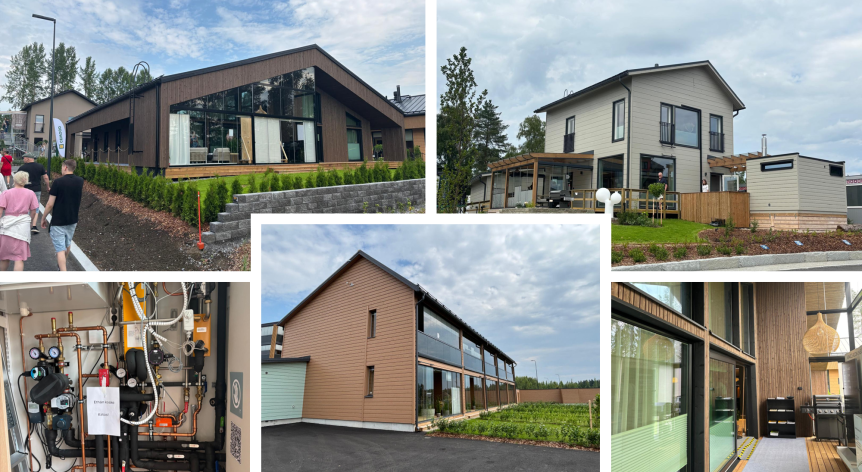
In the summer of 2026 the Fair has been built in the Saikka district of Lempäälä (10 July – 9 August). The area comprises 34 showcase objects — detached houses, an urban compact house, semi-detached and terraced houses, an apartment building, and Saikantalo, which combines a primary school and a day-care centre. Around 350 people will eventually live there. The overarching theme of the entire event is climate wisdom: the municipality even granted plot-price discounts to builders who committed to climate-sustainable solutions.
Timber has already won — in Finland
The most telling observation is one a Finnish visitor can easily overlook: of the 34 objects on the site, only one was a stone house. Everything else is timber — and that is no coincidence, but the statistically expected outcome. According to Rakennustutkimus RTS Oy and the Finnish house-building association Pientaloteollisuus PTT, close to 90% of new Finnish single-family homes are built with a timber or log frame — 88% by building permits in 2024 — while stone houses account for only about 10%, and only a small share of those are brick-clad. In house-package (talopaketti) deliveries the gap is wider still: factory-made, assembled packages are almost exclusively timber, since stone houses are usually laid by hand on site and built to individual architectural designs. In Finland, timber is by far the most popular choice — roughly nine of every ten new homes.
This is the exact mirror image of the Ukrainian market, where more than 95% of new construction is concrete. That is precisely why the Saikka site is an exceptionally apt window for Happy Nordic Living — it is, in effect, a catalogue of what we are bringing to Ukraine.
Industrial timber elements — the essence of HNL
The backbone of Finnish timber construction is industrial timber-element building. Houses assembled from large prefabricated panels are by far the largest category by volume: roughly 60% of all timber homes are built this way. The elements are manufactured in the factory under weather protection, erected quickly on site, and handed over move-in ready. This is exactly the logic HNL brings to the Kyiv region — the same industrial production, the same Nordic quality and appearance. The Fair shows how far standardised factory production can stretch: from a modern Scandinavian single-family home to a dense, urban townhouse.
The terraced houses and compact urban homes are particularly interesting. They are the direct counterpart of HNL Village’s Business tier: an efficient, dense and fully finished home. In Ukraine’s suburbs, where demand is driven precisely by the shortage of renovation labour and buyers want move-in-ready homes, this is the product that solves the buyer’s problem.
Multi-storey construction calls for a sharp eye: even in Finland, the frame of a “timber apartment building” is often still concrete, with wood only on the façade. A genuine multi-storey timber frame is the frontier of both growth and regulation — exactly where HNL’s DBN work in Ukraine is aimed. Solid and glue-laminated timber, in turn, is used deliberately where it is needed: in critical points that carry concentrated loads.
Energy and resilience — the Fair’s most important lesson
The Fair’s essential message lies not in any single house but in how the whole area produces and manages energy. Saikka uses a new low-temperature local heat network delivering heat at around 65°C — which cuts distribution losses and makes efficient use of geothermal heat. Some houses have solar panels and battery storage; the detached houses have fireplaces.
In Finland these are ecological and comfortable choices. In Ukraine they are survival. Low energy consumption, on-site generation, backup power and a heat source that works during a blackout — this is precisely the resilience that the war has made indispensable in Ukraine, and that HNL builds into every home.
Timber’s competitive edge in a concrete market
Timber’s advantage over concrete is exceptionally strong in Ukrainian conditions. An element produced in a factory under weather protection is built fast and to a consistent quality, regardless of site conditions or the season — a decisive edge in a market whose greatest bottleneck is not demand but the availability of labour. A light timber frame speeds up erection and lightens the foundations, energy efficiency is inherent in the structure itself, and adaptability lets production be standardised while the end result is tailored. Combined with the Nordic quality image, which stands high in Ukraine, this creates a competitive position that concrete cannot match.
The shelter — a dual use that saves lives
One feature of Finnish construction deserves special attention for Ukraine: the civil defence shelter. Finnish building regulations require larger buildings to include a shelter that serves everyday life as storage, parking or hobby space and converts into protection in a crisis. This dual-use logic — a space that earns its place every day yet saves lives in an emergency — is directly transferable to Ukraine. It is also the core of HNL’s shelter concept: underground parking that doubles as a civil-protection shelter. In Finland this tradition has been built over decades; in Ukraine the need for it is acute and dictated by war.
Saikantalo at the heart
At the centre of the area stands Saikantalo, a public timber building that unites a primary school and a day-care centre. It is a good reminder that HNL Village is not only homes: the school, the day-care and the community facilities belong in the same block, built from the same material. This whole — home, services and safety in a single Nordic package — is what Happy Nordic Living means.
The Lempäälä site is small and compact, but its message is large: low-energy, ecological, fast-to-build and crisis-resilient timber construction is not the future but the Finnish present. It is exactly what Ukraine needs right now — and exactly what HNL brings there.