

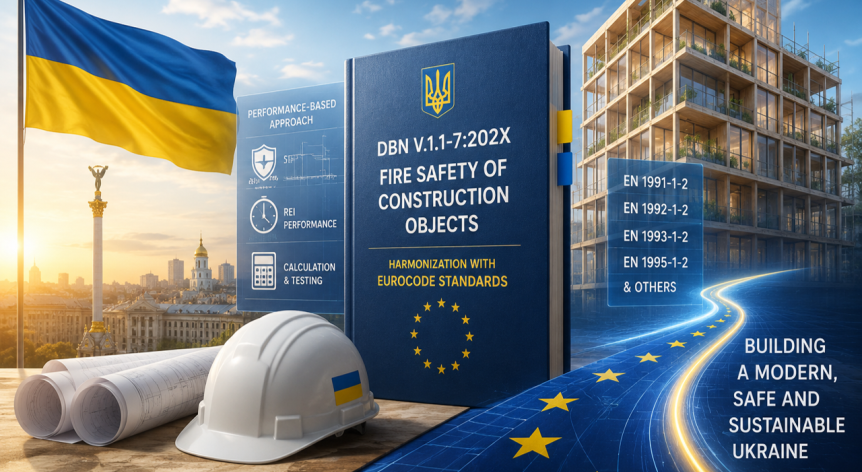
A new draft regulation — DBN V.1.1-7:202X “Fire Safety of Construction Objects.
The long-discussed modernization and Eurocode harmonization of Ukraine’s fire safety regulation for construction objects is now finally gaining real momentum.
A new draft regulation — DBN V.1.1-7:202X “Fire Safety of Construction Objects. General Requirements” — has entered parliamentary processing in the Verkhovna Rada since early May 2026.
This is a very significant step for the future of modern construction in Ukraine, including industrial timber construction.
Happy Nordic Living has also actively participated in discussions around this topic together with Ukrainian authorities, reconstruction institutions and legislative working groups.
What is changing compared to the current DBN V.1.1-7:2016?
The currently valid DBN from 2016 still largely reflects an older Soviet-style regulatory philosophy:
- strong reliance on material-based restrictions,
- emphasis on A1 non-combustible materials,
- and relatively rigid prescriptive interpretation culture.
Although the 2016 version already contained some references to Eurocodes, engineering calculations and performance-based approaches, these remained mostly theoretical and difficult to implement in practice.
The new DBN draft changes the direction clearly toward a modern European engineering model.
The biggest improvements are:
- much stronger recognition of performance-based fire engineering,
- wider and more systematic use of Eurocode references,
- clearer acceptance of calculation- and testing-based approval methods,
- stronger REI fire performance logic,
- and recognition of alternative structural systems.
In practice, the new approach increasingly asks:
“Can the structure demonstrably achieve the required fire safety performance?”
instead of only:
“What material is the structure made from?”
This is exactly how modern multi-storey timber buildings are approved across much of Europe today.
What still needs improvement?
Despite the very positive direction, the draft still contains one major contradiction.
At the same time as it introduces modern performance-based engineering principles, several sections still require many structures to use A1 non-combustible materials.
This creates uncertainty especially for modern engineered timber systems.
For example:
- timber frame systems,
- CLT structures,
- encapsulated timber systems with gypsum protection and mineral wool,
- and hybrid timber systems
can already achieve extremely high REI60–REI120 fire resistance levels through engineering design, testing and calculations — even though timber itself is not an A1 material.
The regulation would become much clearer and stronger if the focus moved fully from material type toward demonstrated fire performance.
This is especially important for buildings below 26.5 meters in height (roughly up to 8 storeys), where modern European timber apartment buildings could realistically become possible under Eurocode principles.
Another important challenge is the current lack of accredited fire testing laboratories and certification infrastructure in Ukraine. In the beginning, cooperation with EU-accredited laboratories — for example in Poland — could provide a practical transitional solution.
Why does this matter?
If Ukraine succeeds in implementing a clear, modern and predictable Eurocode-aligned fire safety framework, the impact could be very significant:
- more international investments,
- better access to IFI financing and insurance,
- faster industrial reconstruction,
- new factories and jobs,
- higher quality housing,
- lower carbon emissions,
- and the emergence of a modern industrial timber construction sector in Ukraine.
This is not only about construction regulation.
It is about building a modern European Ukraine.